
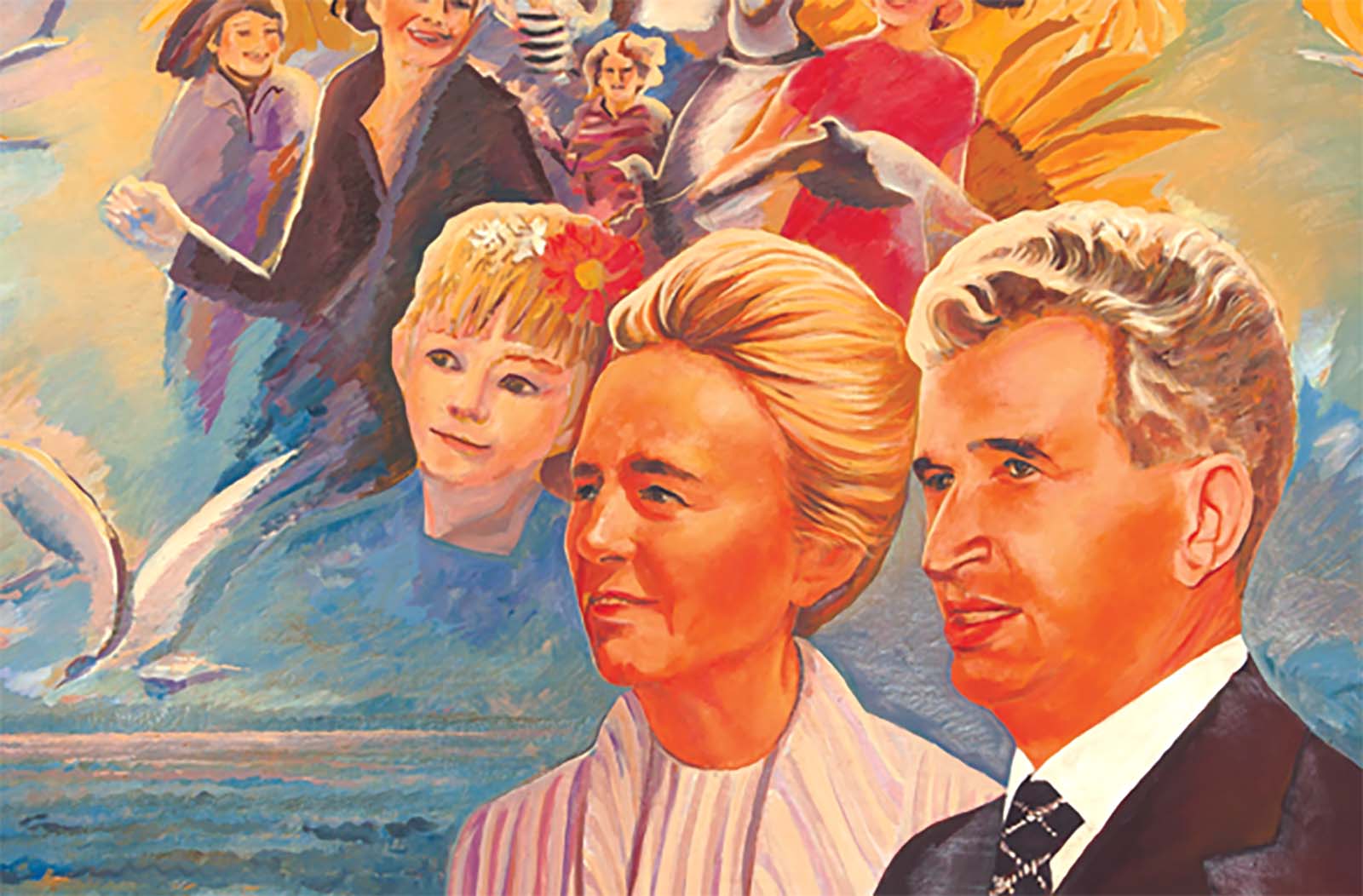

Few episodes in modern history reveal the lengths a regime will go to manufacture consent quite like the personality cult Nicolae Ceaușescu built around himself and, eventually, his wife.
During the Cold War, Romania stood apart even within the Eastern Bloc — not for its resistance to Soviet orthodoxy, but for the sheer intensity of its leader’s self-glorification.
What Ceaușescu constructed was not merely propaganda. It was a total reordering of public reality, one painting, poem, and official portrait at a time.
The machinery behind this cult was set in motion with the 1971 July Theses, a sweeping ideological reversal that dismantled the relative openness of the 1960s and reimposed Stalinist totalitarianism.
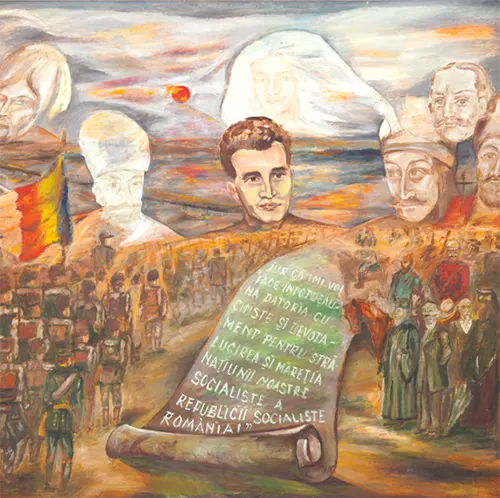
“Representative Personalities in the History of the Homeland”. Made at the Circle of Pioneers in Drăgășani. Commissioned by the Olt County Party Committee and offered to Ceaușescu in January 1978, on the occasion of his 60th birthday.
Inspired by what Ceaușescu witnessed during visits to North Korea and China, where Kim Il Sung and Mao Zedong had elevated themselves to near-mythical status, Romania’s leader set about constructing a similar edifice at home.
Strict nationalist ideology replaced liberalization, and socialist realism became the mandatory aesthetic of Romanian cultural life.
In its early years the cult centered solely on Ceaușescu himself, but by the early 1980s his wife Elena had been folded into it as well, one of the very few spouses of a communist leader to become a genuine political force in her own right.
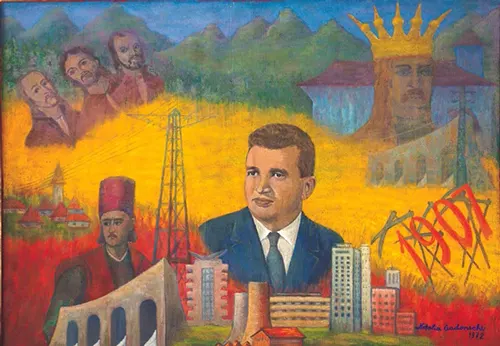
“Nicolae Ceaușescu and Scenes from the History of the People”. Offered to Ceaușescu by Natalia and Nicolae Gadonschi-Ţepeş on the occasion of his 54th birthday (January 1972).
Ceaușescu had already consolidated authority after becoming General Secretary of the Romanian Communist Party in 1965, the most powerful role in the state.
Two years later he assumed the leadership of the State Council, effectively becoming head of state.
In 1974 the office was elevated to the presidency of the republic, a position with sweeping executive powers that further reinforced his near-absolute control.
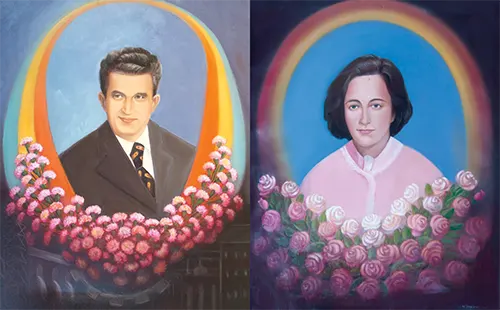
Two “Homage” paintings offered by the Sibiu County Party Committee on the occasion of Nicolae Ceaușescu’s birthday in 1983 and 1989.
Around the same time, the regime introduced a ceremonial presidential sceptre meant to symbolize authority, a gesture so unusual that the surrealist artist Salvador Dalí famously sent a telegram praising the decision, an ironic message that Romania’s state-controlled press printed without recognizing its sarcasm.
From childhood onward, Romanian schoolchildren absorbed poems and songs extolling the unity of party, leader, and nation.
The purpose was not simply to generate enthusiasm, it was to make any public opposition structurally impossible. Ceaușescu was presented as infallible by definition, a figure beyond criticism.
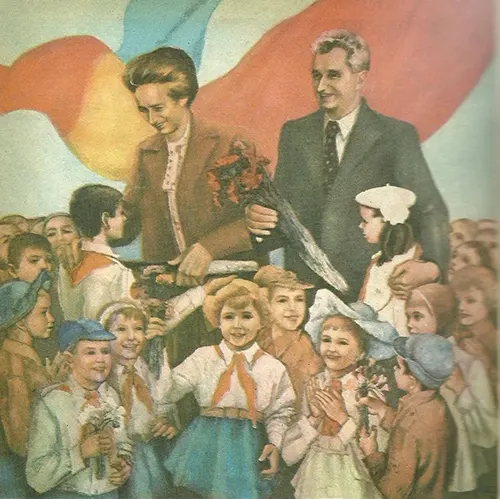
“Homage”; Author: Constantin Nitescu.
The media played its part with remarkable creativity. State outlets portrayed him as a communist theoretician of genius who had made substantial contributions to Marxism-Leninism, a thinker whose ideas were the wellspring of all national progress.
His collected works were reprinted at regular intervals, translated into multiple languages, and eventually stretched across dozens of volumes that filled Romanian bookstores.
Broadcasters spoke of the “golden era of Ceaușescu” and deployed a rotating cast of elaborate titles: “guarantor of the nation’s progress and independence,” “visionary architect of the nation’s future,” and dozens more.
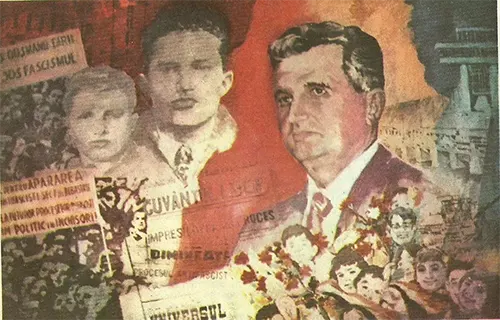
“Pages of History”; Author Gheorghe Ionita.
Writer Dan Ionescu, working for Radio Free Europe, catalogued the full range of epithets Romanian intellectuals had been made to apply to their leader — among them “celestial body,” “secular god,” “Prince Charming,” “morning star,” “titan,” and “saviour.” Most simply called him the Conducător: the leader.
Both Ceaușescus were acutely conscious of their public image, and the state apparatus bent itself to protect it. Official photographs consistently showed them as they appeared in their late 40s.
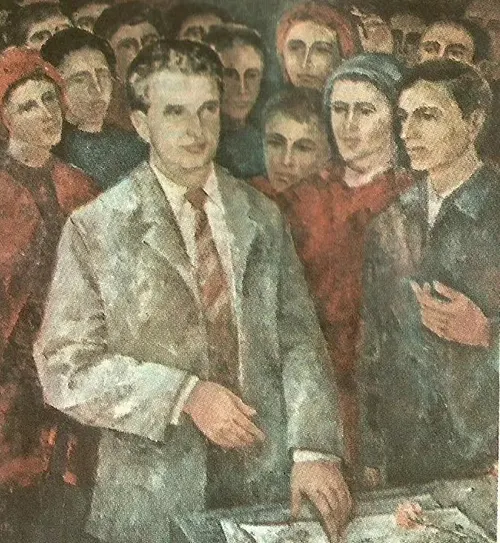
Dialogue with the young generation; Author: Gheorge Gh. Anghel.
Romanian state television operated under strict instructions to present them in the most flattering possible light. Camera operators were forbidden from emphasizing Ceaușescu’s relatively short stature.
Elena, self-conscious about her profile, was never filmed from the side.
At one point, all official portraits showed him in a consistent half-profile with only one ear visible — until a joke circulated connecting this to a Romanian idiom for madness, at which point the portraits were swiftly replaced with images in which both ears were prominently on display.
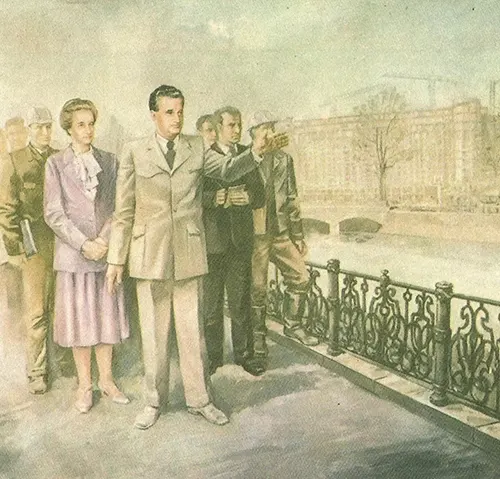
A painting with the Ceausescus on the banks of the Dambovita River.
Painting became one of the more revealing vehicles for this cult. On canvas, Ceaușescu was depicted allegorically across three life stages — child, adolescent, and mature leader — tracing a journey from youthful idealism to heroic statesman.
Some works placed him alongside figures from Romanian history, connecting the sitting dictator to the rulers and warriors of earlier centuries, as though political power had flowed unbroken from the medieval principalities to his own desk in Bucharest.
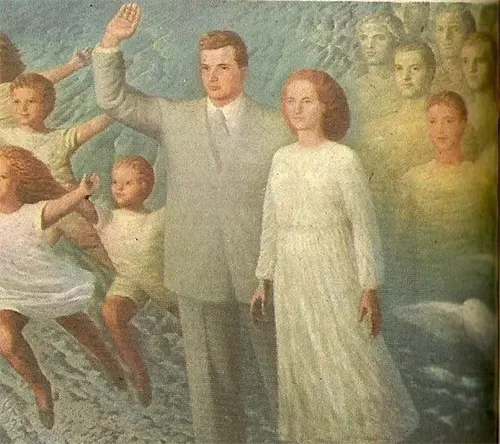
“Homage”; Author: Sabin Balasa.
Other paintings captured moments from his personal history, presented not as biography but as mythology. The artists behind these works ranged widely in talent and in motivation.
Some were compelled to paint. Others appear to have genuinely believed in what they were producing, channeling real reverence for a man they had been conditioned to regard as exceptional.
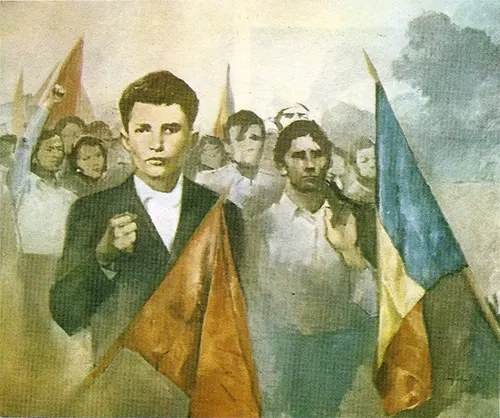
“Revolutionary Youth”; Author Eugen Palade.
Ceaușescu’s birthday, marked as a national holiday, became the annual occasion for publishing volumes of tribute compiled from Romania’s intellectual class.
The first major collection, titled Omagiu — “Homage” — appeared in 1973, a large and elaborately produced work. By the 1980s these volumes arrived every year, filled with prose, poetry, and songs. That intellectuals were expected to contribute was understood.
That many complied without visible protest said everything about the world the cult had created — one in which the distance between sincere belief and calculated survival had, for most people, long since ceased to matter.
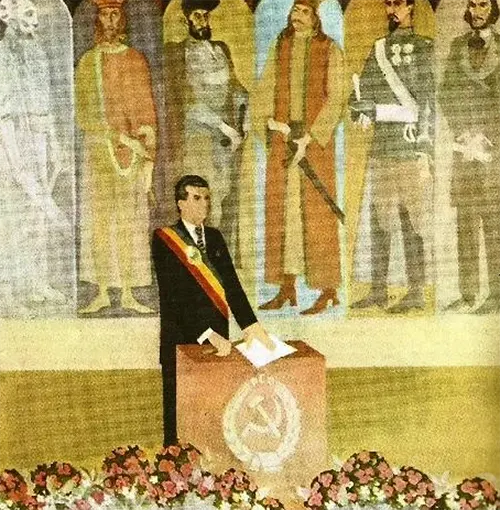
The first president of Romania (painting by Constantin Piliuta).
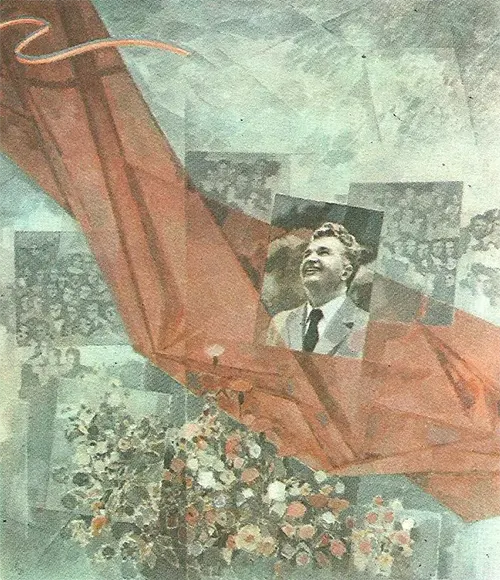
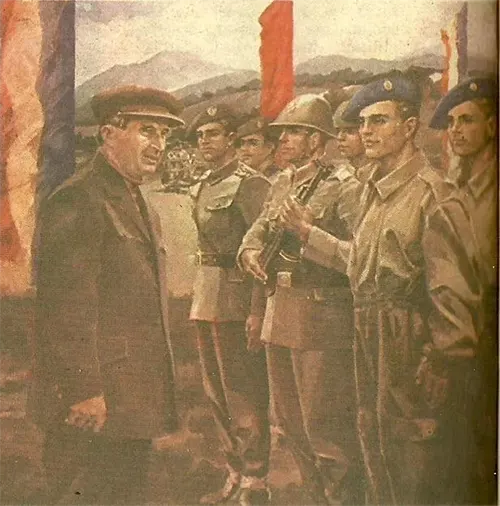
“Honor to the Supreme Commander”; Author: Lt. Col. Gh. Ionita.
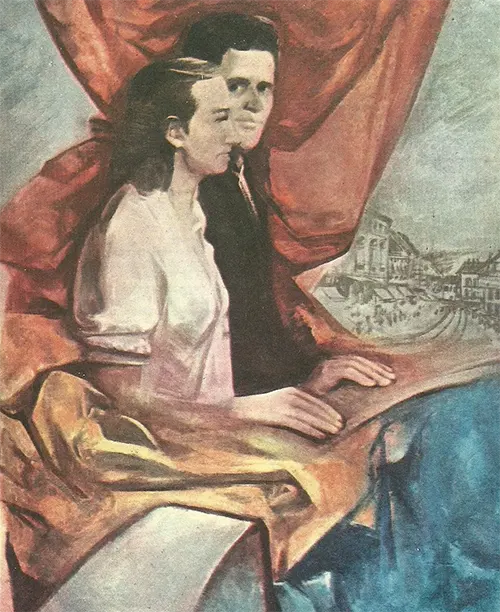
“Rally in front of the University, August 1944”; Author: Doru Rotaru.
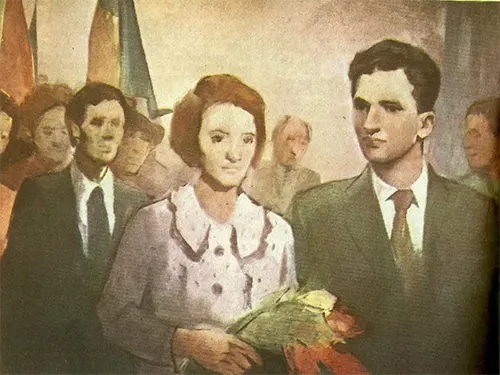
“May 1, 1939” Author: Eugen Palade.
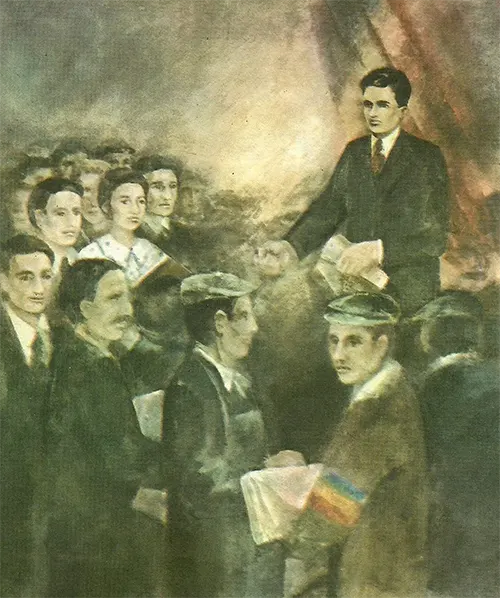
“In the years of illegality”; Author Corneliu Ionescu.
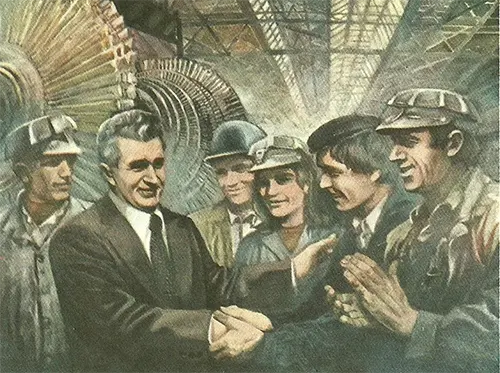
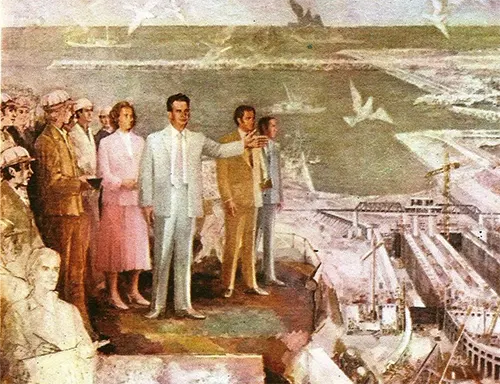
“Working Visit”; Author: Vasile Pop Negresteanu.
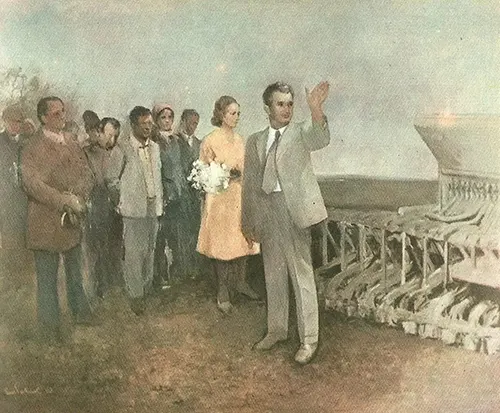
Visiting the proletariat. Author: Eugen Palade
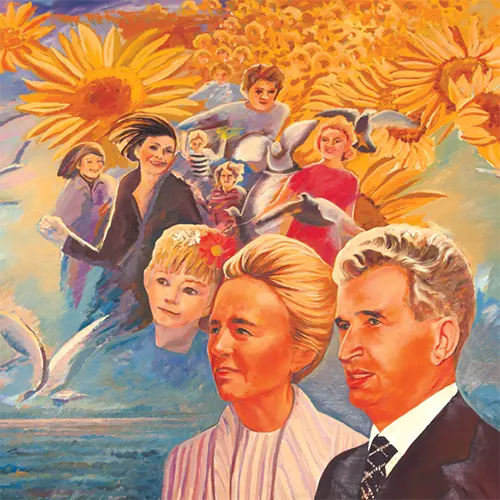
“Homage”. Commissioned by the Committee on the Issues of the People’s Councils (1984)..
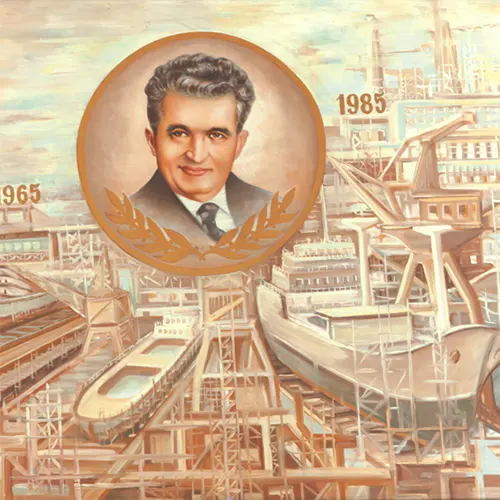
“The Hero of Socialist Romania”. Commissioned by the Olt County Party Committee and and offered to Ceaușescu in January 1988, on the occasion of his 70th birthday.
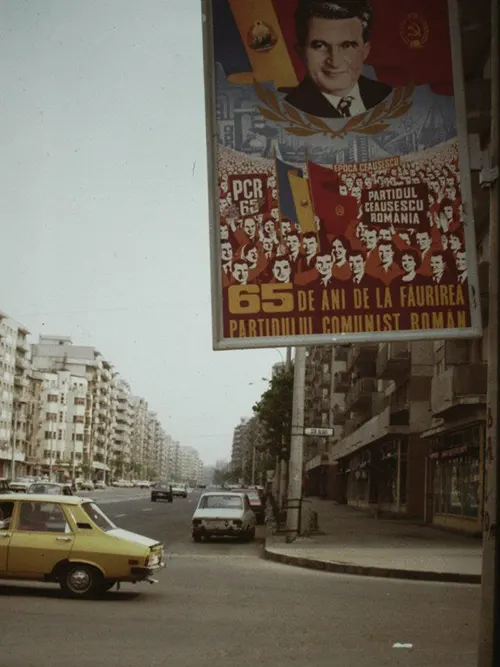
A propaganda poster on the streets of Bucharest, 1986. The caption reads “65 years since the creation of the Romanian Communist Party”, while in the background it reads “Ceaușescu Era” and “The Party. Ceaușescu. Romania”
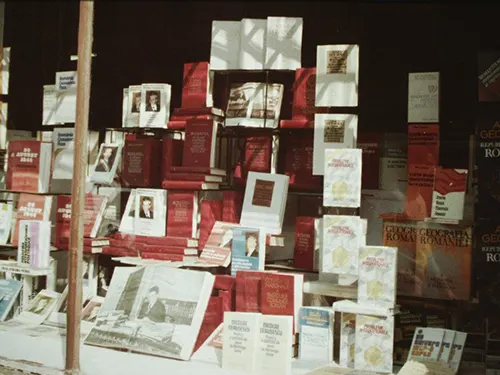
A Bucharest bookstore window, showcasing Ceaușescu’s work, c. 1986.
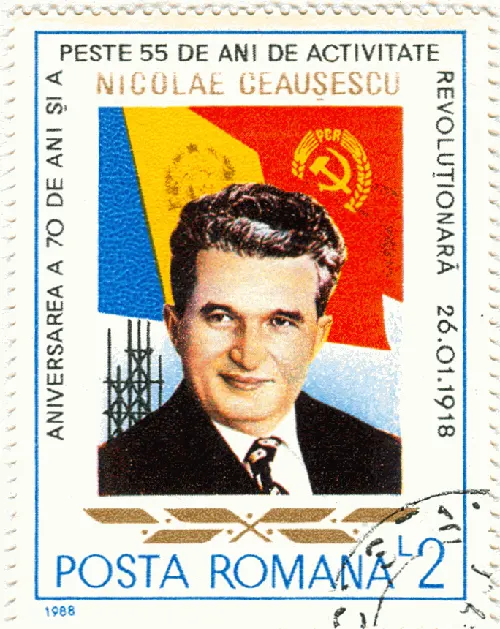
Stamp commemorating the 70th birthday (and 55 years of political activity) of Nicolae Ceaușescu, 1988.
(Photo credit: Socialist Times via Romanian Archives / Wikimedia Commons).