
New York City in the 1970s was a city on the edge. Overcrowded, underfunded, and gripped by a spiraling crime wave, it tested the limits of every institution trying to hold it together, none more so than the men and women of the New York City Police Department.
The photographs taken during this era capture something that statistics alone cannot: what it actually looked like to show up for work in one of the most volatile urban environments in American history.
That record exists in large part because of Leonard Freed, a documentary photographer whose unflinching eye followed the NYPD through the trenches of one of the department’s most punishing decades.
.jpg)
1978. Police officer playing with the children in Harlem.
The city’s financial collapse set the stage for everything that followed. A severe fiscal crisis drained municipal budgets, and the NYPD absorbed some of the deepest cuts.
The number of uniformed officers fell by thousands over the course of the decade, leaving those who remained to cover beats that had once been shared among far larger teams.
The math was brutal and simple: fewer officers, more ground, and a city that was coming apart at the seams.
.jpg)
1972. Detention facilities.
Crime statistics from the period tell a sobering story. Robbery, assault, and violent crime rose sharply throughout the decade, turning certain neighborhoods into places where danger was not a possibility but a near-certainty.
Areas of the South Bronx, Harlem, and Brooklyn saw abandonment, arson, and street violence overlap in ways that overwhelmed conventional policing strategies.
Officers working these precincts dealt with a relentless volume of incidents, often with outdated equipment, aging patrol cars, and department resources stretched well beyond their limits.
.jpg)
1978. Investigators from the 9th Precinct with his lieutenant Edward Manetho.
The 911 system, still relatively new at the time, fundamentally shaped how officers spent their shifts.
Rather than walking a neighborhood beat and building the kind of community familiarity that might deter crime before it happened, most officers moved from call to call, reactive by necessity.
The gap between response and prevention widened every year, and the pressure on individual officers grew accordingly. There was little time between incidents to reset, debrief, or even catch a breath.
.jpg)
1978. Investigators from the 9th Precinct with his lieutenant Edward Manetho.
What made the job particularly grueling was not just the physical danger, though that was real and constant.
It was the combination of understaffing, public distrust, and a city government that seemed perpetually on the verge of insolvency.
Officers took on more shifts, covered for absent colleagues, and worked in an environment where morale was difficult to sustain.
.jpg)
1978. The police intervened when a family quarrel escalated from a simple skirmish in a fight.
Drug markets had expanded aggressively across multiple boroughs, fueling property crime and adding another layer of unpredictability to street-level policing.
Burglaries, car thefts, and armed robberies were not occasional events; they were woven into the daily fabric of city life.
And yet, through all of it, the work continued. Officers showed up, suited up, and headed out into a city that demanded everything from them while offering relatively little in return.
.jpg)
1978. Small narkobaryga shows one of his scars resulting from multiple stab wounds.
Freed was there to document it. Working with close access and an instinct for the unguarded moment, he captured patrol officers in cramped precinct rooms, detectives working crime scenes under dim light, and uniformed cops navigating streets that bore little resemblance to the postcard version of New York.
There is grit in these images, but also something quieter: the routine professionalism of people doing a difficult job because it needed to be done.
Freed understood that the most powerful photographs are rarely the dramatic ones, and his work from this period reflects that discipline.
.jpg)
1978. The district shows traces of drug dealers stab wounds he received while working on the street. The area is so dangerous that police are walking around with two guns and a pocket knife. A small pair of binoculars is needed to monitor the drug dealers in the distance.
Looking at these photos now, decades removed from the chaos of that era, it becomes easier to understand why the 1970s occupy such a complicated place in New York City history.
The city that eventually emerged, stabilized by fiscal reform and later falling crime rates, carried the scars of what it had endured.
The officers Freed photographed were working through the worst of it, in real time, with no guarantee of what came next.
.jpg)
1972. A police officer on the roof of one of New York’s schools oversees drug dealers trying to sell drugs to schoolchildren. “These school guards are useless” – said one of the teachers. “Calm yourself can be felt only with real police officers, armed with a real gun and on duty in the corridors of the school. Then I’m no longer a teacher. I overseer.”
.jpg)
1972. “If I had to, I could have shot” – said one policeman. “But I prefer not to think about it. Most of the police in their entire career there is no such need. Hopefully, I’m one of them.”
.jpg)
1975. Department photo identification at police headquarters in New York. Special machines have a sketch of a wanted criminal.
.jpg)
1978. Two officers check a suspicious car. According to the procedure they come back with his hand on the handle of a revolver.
.jpg)
1979. The funeral of a police officer who was killed on duty.
.jpg)
1979. Police divers.
.jpg)
1979.
.jpg)
1979. A group of residents accused Chelsea staff of the 10th section of ill-treatment of detainees.
.jpg)
1979. Shooting galleries.
.jpg)
1979. Reid in shooting galleries.
.jpg)
1979. Toilet clogged gelatin capsules and syringes.
.jpg)
1979. In a raid was attended by about 12 plainclothes officers. Police used a circular saw and hydraulic cutters to get into the apartment. Inside they found a large quantity of drugs packaged in boxes and the woman who this morning has been released on bail. In the window we could see how the street going to small drug dealers and wait for the police to leave.
.jpg)
1979. The funeral of a police officer.
.jpg)
1979. Curator of the Museum of the New York Police holds an artifact of the Romantic era gangster wars.
.jpg)
1972. In the prison.
.jpg)
1972. Homicide investigators show photos of suspects residents of the district.
.jpg)
1972. “This is a real carousel” – said a police officer. “We’re taking prostitutes off the streets, they pay a small fine and come back the same evening. This is just a nuisance.” “The inconvenience to anyone” – I asked. For customers, he said, for the customers.
.jpg)
1972. An underground passage from the building of the prison to the courthouse.
.jpg)
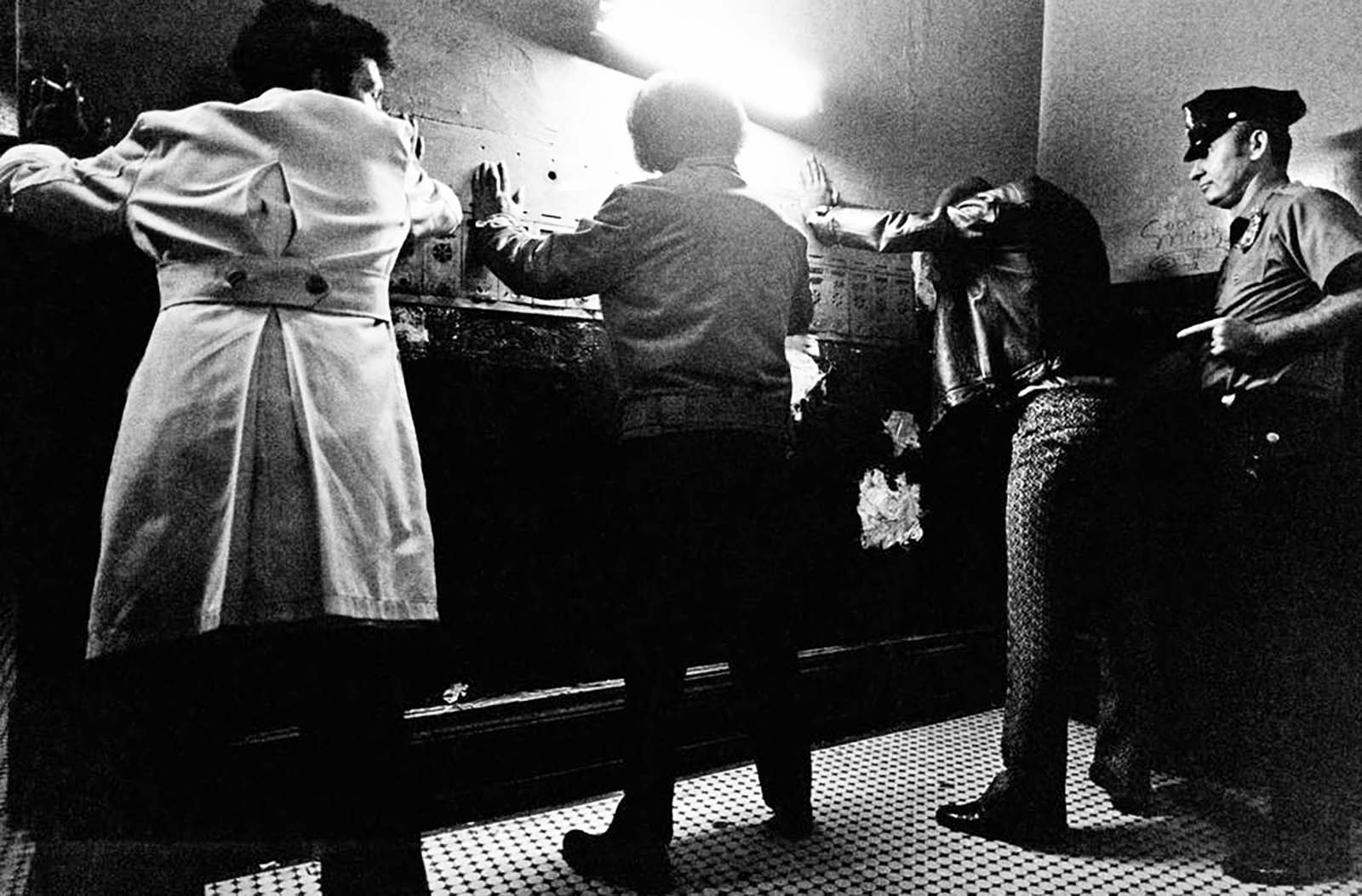
1972. A search of suspects.
.jpg)
1972. This is not a bank, and the regular grocery store.
.jpg)
1972. A security guard at a clothing store.
.jpg)
1972. Expert studies fingerprints.
.jpg)
1972. A ballistic examination.
.jpg)
1972. Expert studies bullet.
.jpg)
1972. Employees homicide working around the clock over the murder of two policemen. “If necessary, we will work in our own time” – said one of the detectives.
.jpg)
1972. Mounted police raise the fallen man in the street.
.jpg)
1978. Officer Steve Kreychi wears a bulletproof vest before heading out to patrol the neighboring buildings.
.jpg)
1972. The boy came to the police station and said that he was left home alone and he needs help.
.jpg)
1972. “Is not she lovely?” – He said.
.jpg)
1978. Much of the work of the patrol is to just stand and watch.
.jpg)
1978. Fashionistas look like tough guys, but in reality gruel and namby-pamby.
.jpg)
1978. Thief caught in the process of breaking the shop wall asking him to return his tools.
.jpg)
1978. Quarter of a burnt-out and abandoned buildings girl ran out and waved a police car. She was raped by friends of her boyfriend while he watched. When the police went with her to find out what’s what, the neighbors began to shout after her – “slut”, and trying to tear off her clothes.
.jpg)
1978. Police separate the two fighting teens.
.jpg)
1978. Patrol scooter.
.jpg)
1978. The suspect resisted arrest.
.jpg)
1978. The officer draws detainees.
.jpg)
1979. Volunteers from the auxiliary police are instructed in the basement of the police station. In one of the sections of a staff member told me that his box in the locker room was broken into and some uniforms stolen. “Who could have done it?” – I asked. “More Cops” – he said. “They see us as strikebreakers.”
.jpg)
1979. The young man says a police officer as he crashed the car.
.jpg)
1979. A police officer on duty near the set of the film. There is the increasingly popular “cult cop” when representatives of sexual minorities piece dress uniform, walking around with handcuffs, keys and whistle on a belt.
.jpg)
1979. A protester refused to leave the roadway and was taken away by force.
.jpg)
1979. Rocking.
.jpg)
1979. Police.
.jpg)
1979. The funeral of a police officer who was killed on duty.
.jpg)
1979. Police chiefs.
.jpg)
1979. The funeral of a police officer who was killed on duty.
.jpg)
1979. The funeral of a police officer who was killed on duty.
.jpg)
1979. Detective is an inventory of confiscated in the raid guns.
.jpg)
1979. Children play in a police car in one of the hottest days of July.
.jpg)
1979. Police rushed on call and grabbed the teenager suspected of robbing a supermarket. The store manager said that they got the wrong man. Later inspection showed that the teenager had been involved in other crimes.
.jpg)
1979. Demonstration.
.jpg)
1979. The officer at the street fair.
.jpg)
1979. The officer shoots a gun with an ankle before school in the gym.
.jpg)
1979. Reid in shooting galleries.
.jpg)
1979. Reid in shooting galleries. At the local slang, it is called a “shooting gallery”.
.jpg)
1979. Policeman artist paints a portrait of the suspect.
.jpg)
1979. Abandoned building in which the shooting galleries.
.jpg)
1979. Police officers during a visit to a countercultural clothing boutique.
.jpg)
1979. Evening Halloween.
.jpg)
1978.
.jpg)
1978. A police officer checks was a bad man, or is he just drunk.
.jpg)
1978. The man was found lying in the street and taken to hospital.
.jpg)
1978. The detainee and the officer looked at each other in a police station.
.jpg)
1979. December 31. New Year’s Eve.
.jpg)
1979. Night at the police station.
(Photo credit: Leonard Freed / Bygonely).